Blockchain and Crypto News

Don’t miss real-time updates

Decentral Block Post

Access real-time blockchain and cryptocurrency news updates from around the globe.

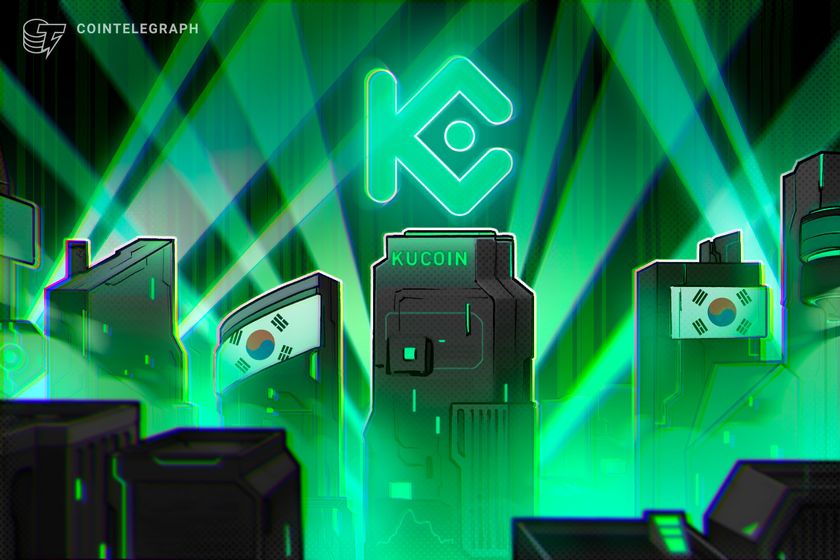
KuCoin to reenter South Korea after securing key markets: CEO

Crypto exchange KuCoin said that it may reenter South Korea after its platform was blocked in the country. 

On March 21, South Korean regulators ordered Google Play to block access to exchanges that were not compliant with the requirements needed to operate in the country. On April 11, South Korea’s Financial Services Commission (FSC) ordered the Apple Store to block unregistered crypto exchanges

KuCoin was among those affected by the country’s crackdown on unregistered platforms that were previously available. While the platform is now unavailable to South Koreans, it has not fully abandoned the jurisdiction. 

In an exclusive interview with Cointelegraph, KuCoin’s newly appointed CEO, BC Wong, said that the crypto exchange has plans to reenter the country. 

Wong (left), KuCoin EU CEO Oliver Stauber (middle) and Cointelegraph reporter Ezra Reguerra (right) at the Token2049 event in Dubai. Source: Market Across

Regulators drive global players away from local markets

Wong told Cointelegraph that before the exchange can reenter South Korea, it plans to secure compliance with major jurisdictions first. He said: 
KuCoin to reenter South Korea after securing key markets: CEO
Continue reading

European Union to ban anonymous crypto and privacy tokens by 2027

The European Union is set to impose sweeping Anti-Money Laundering (AML) rules that will ban privacy-preserving tokens and anonymous cryptocurrency accounts from 2027.

Under the new Anti-Money Laundering Regulation (AMLR), credit institutions, financial institutions and crypto asset service providers (CASPs) will be prohibited from maintaining anonymous accounts or handling privacy-preserving cryptocurrencies, such as Monero (XMR) and Zcash (ZEC).

“Article 79 of the AMLR establishes strict prohibitions on anonymous accounts [...]. Credit institutions, financial institutions, and crypto-asset service providers are prohibited from maintaining anonymous accounts,” according to the AML Handbook, published by European Crypto Initiative (EUCI).

The AML Handbook. Source: EUCI

The regulation is part of a broader AML framework that includes bank and payment accounts, passbooks and safe-deposit boxes, “crypto-asset accounts allowing anonymisation of transactions,” and “accounts using anonymity-enhancing coins.”

Related: Eric Trump: USD1 will be used for $2B MGX investment in Binance

European Union to ban anonymous crypto and privacy tokens by 2027
Continue reading

Circle’s Refund Protocol, explained: Bringing refunds to stablecoin payments

Why are refunds important in stablecoin payments?

Anyone who has used traditional payment systems will likely be familiar with refunds and chargebacks. If a purchase goes wrong, like receiving damaged items or not receiving the product at all, the payer can file a complaint with the seller to recover their funds. This process of refunds builds trust between payers and sellers, ensuring secure transactions for both sides.

However, stablecoin transactions differ significantly. Unlike credit cards or PayPal, stablecoin payments are generally irreversible. Once sent, the payment is final, with no standard way to dispute or reverse it if issues arise, which can make payers wary of using stablecoins for daily purchases.

This highlights the importance of refunds in the stablecoin ecosystem. Just as payers rely on protections with traditional payment methods, stablecoin transactions need comparable systems to inspire confidence. 

Without options to dispute or reverse payments, payers may avoid stablecoins for online shopping or other transactions. A clear, reliable refund system could make stablecoin payments safer and more attractive for payers, whether purchasing digital goods, services or physical items.

Circle’s Refund Protocol, explained: Bringing refunds to stablecoin payments
Continue reading

Bitcoin hodler unrealized profits near 350% as $100K risks sell-off

Key points:

Bitcoin long-term holders are about to hit a level of unrealized profit, which has traditionally caused them to sell.

That level coincides with the return to a six-figure BTC price.

Order book data suggests that bulls may not succeed in keeping the upside going.

Bitcoin (BTC) risks a “notable increase” in selling from its older investors if price rises further, warns onchain analytics firm Glassnode.

Bitcoin hodler unrealized profits near 350% as $100K risks sell-off
Continue reading

Movement Labs suspends co-founder following MOVE market turmoil

Movement Labs confirmed the suspension of its co-founder, Rushi Manche, following controversies over a market maker deal that he brokered.

Movement announced the suspension of Manche in a May 2 X post, explaining that the “decision was made in light of ongoing events.” The decision follows Coinbase's recent decision to suspend the Movement Network (MOVE) trading, citing the token’s failure to meet its listing standards.

Source: Movement

The suspension came after a recently announced third-party review requested by the Movement Network Foundation into an agreement orchestrated by Manche with Rentech — the latter helped broker an agreement with market maker Web3Port. Private intelligence firm Groom Lake is conducting the investigation.

This was followed by Web3Port reportedly selling the 66 million MOVE that it gained through the deal — about 5% of the total supply. This led to $38 million in downward price pressure in December 2024.

Groom Lake refused to comment on the investigation.

Movement Labs suspends co-founder following MOVE market turmoil
Continue reading

From digital identity to outer space: Projects push crypto use cases

As the crypto space developed, blockchain use cases expanded from simple digital currencies and non-fungible tokens (NFTs) to more complex areas such as digital identity verification and telecommunications. 

Ahead of the Token2049 event in Dubai, Cointelegraph spoke with Spacecoin CEO Stuart Gardner, Spacecoin founder Tae Oh, and Humanity Protocol founder Terrence Kwok to explore how they use blockchain to improve certain industries. 

From addressing challenges like verification in the artificial intelligence era to bringing internet connectivity to developing countries, projects are integrating blockchain to solve problems in different industries.  

Digital identity verification to combat the AI threat 

As artificial intelligence developed, the technology brought improvements that people could benefit from. However, the technology was also adopted by malicious actors who used the tech to perform AI-assisted hack research and deepfake scams.  

Kwok told Cointelegraph that just two years ago, the idea of having to prove you’re human seemed “crazy.” However, with today’s advancements in AI, it has become remarkably easy to fake being a real person.

From digital identity to outer space: Projects push crypto use cases
Continue reading

Stablecoins: Depegging, fraudsters and decentralization

Opinion by: Merav Ozair, PhD

Lately, stablecoins are everywhere — this time around, headed by “traditional” financial institutions. Bank of America and Standard Chartered are considering launching their own stablecoin, joining JPMorgan, which launched its stablecoin, JPM Coin — rebranded as Kinexys Digital Payments — to facilitate transactions with their institutional clients on their blockchain platform, Kinexys (formerly Onyx). 

Mastercard plans to bring stablecoins to the mainstream, joining Bleap Finance, a crypto startup. The aim is to enable stablecoins to be spent directly onchain — without conversions or intermediaries — seamlessly integrating blockchain assets with Mastercard’s global payment rails. 

In early April 2025, Visa joined the Global Dollar Network (USDG) stablecoin consortium. The company will become the first traditional finance player to join the consortium. In late March 2025, NYSE parent Intercontinental Exchange (ICE) announced that it is investigating applications for using USDC (USDC) stablecoin and US Yield Coin within its derivatives exchanges, clearinghouses, data services and other markets.

Why the renewed interest in stablecoins?

Stablecoins: Depegging, fraudsters and decentralization
Continue reading

Artificial general intelligence (AGI): Can it really think like a human?

What is AGI?

When the lines blur between man and machine, you’re looking at artificial general intelligence (AGI). Unlike its counterpart, artificial narrow intelligence (ANI), which is the use of AI for solving individual problem statements, AGI represents artificial intelligence that can understand, learn and apply knowledge in a way that is indistinguishable from human cognition.

AGI is still theoretical, but the prospect of artificial intelligence being able to holistically replace human input and judgment has naturally attracted plenty of interest, with researchers, technologists and academics alike seeking to bring the concept of AGI to reality. 

Yet another strand of prevailing research seeks to explore the feasibility and implications of AGI vs. ANI in a world increasingly shaped by AI capabilities. 

Indeed, while ANI has already transformed various industries, AGI’s potential goes far beyond. Imagine a world where machines can not only assist humans in their tasks but also proactively understand the drivers behind specific tasks, predict outcomes, and autonomously create innovative solutions to achieve optimal results. This paradigm shift could revolutionize healthcare, education, transportation and countless other fields.

Artificial general intelligence (AGI): Can it really think like a human?
Continue reading

Crypto in ‘gamble mindset’ as memecoin mentions hit YTD high: Santiment

Online discussions about memecoins have hit a year-to-date high, gaining considerable attention after sentiment cooled earlier in the year, according to onchain analytics platform Santiment. 

Two weeks ago, discussions around Bitcoin (BTC) and layer-1 protocols peaked during the market volatility brought on by the Trump administration’s sweeping tariffs. However, that’s since shifted to high market cap memecoins, Santiment marketing director Brian Quinlivan said in a May 1 blog post.

“Online discussions about these high-risk tokens have proliferated as traders embrace a gamble mindset, rather than a calculated investment approach,” he said.

“This is a telltale sign that traders are increasingly investing based solely on speculation and short-term gains,” Quinlivan added.

Online discussions about memecoins have hit a 2025 high, surpassing discussions about Bitcoin. Source: Santiment

Quinlivan said the overall crypto market rose 10% in the past eight days, but Bitcoin only gained 7%, which indicates traders are flocking to more speculative assets.

Crypto in ‘gamble mindset’ as memecoin mentions hit YTD high: Santiment
Continue reading

Riot Platforms posts Q1 loss, beats revenue estimates

Bitcoin miner Riot Platforms has reported its highest-ever quarterly revenue, but still posted a loss as mining costs have nearly doubled compared to the same time last year and it moves to bolster its facilities.

“We achieved a new record for quarterly revenue this quarter, at $161.4 million,” Riot CEO Jason Les said in a May 1 report for its first quarter 2025 earnings. The company just surpassed Wall Street estimates of $159.79 million by 1%.

Riot’s Q1 revenue was a 50% jump compared to the same quarter a year ago.

Riot blames “halving event” for expenses

The firm reported a net loss of $296,367 over Q1, a 240% decrease from the $211,777 net income it posted in the year-ago quarter.

Riot said that the average cost to mine Bitcoin (BTC) over the quarter was $43,808, almost 90% more than the $23,034 it cost to mine Bitcoin in the same period last year.

Riot Platforms posts Q1 loss, beats revenue estimates
Continue reading

US Treasury wants to cut off Huione over ties to crypto crime

The US Treasury Department wants to block the Cambodia-based Huione Group from accessing the US banking system, accusing it of helping North Korea’s state-backed Lazarus Group to launder its crypto.

The Treasury’s Financial Crimes Enforcement Network (FinCEN) proposed on May 1 to prohibit US financial institutions from opening or maintaining correspondent or payable-through accounts for or on behalf of the Huione Group.

Huione Group has established itself as the “marketplace of choice for malicious cyber actors” like the Lazarus Group, who have “stolen billions of dollars from everyday Americans,” US Treasury Secretary Scott Bessent said in a May 1 statement.

“Today’s proposed action will sever Huione Group’s access to correspondent banking, degrading these groups’ ability to launder their ill-gotten gains.”

Huione Group has set up a network of businesses, which includes payment service platform Huione Pay PLC, the crypto exchange Huione Crypto, and Haowang Guarantee, an online marketplace offering illicit goods and services.

Although the conglomerate doesn’t have correspondent accounts with US financial institutions, it has accounts with foreign firms with US correspondent accounts, FinCEN noted in its rulemaking submission.

US Treasury wants to cut off Huione over ties to crypto crime
Continue reading

SEC files to drop crypto promo case against YouTuber Ian Balina

The US Securities and Exchange Commission has filed to drop another of its crypto lawsuits, this time its unregistered securities sales case against crypto influencer and YouTuber Ian Balina. 

The SEC said in a May 1 joint stipulation with Balina to an Austin federal court that it “believes the dismissal of this case is appropriate,” citing the work of the agency’s Crypto Task Force.

The agency didn’t give a reason for wanting to dismiss its case, but said its decision “does not necessarily reflect the Commission’s position on any other case.”

Balina told Cointelegraph in March that the SEC had informed him it would recommend the court dismiss the case and claimed the agency’s actions were based on a shift in the agency’s priorities.

“Obviously, the new administration is pro-crypto,” Balina said. The SEC has seen a change in leadership under US President Donald Trump, who appointed former crypto lobbyist Paul Atkins to chair the agency.

SEC files to drop crypto promo case against YouTuber Ian Balina
Continue reading

Sky pitches ousting Maker token to complete upgrade

Decentralized finance (DeFi) lending platform Sky has pitched a proposal to finalize its upgrade from Maker by replacing its governance token and enabling staking.

The proposal, posted on May 1 to Sky’s decentralized autonomous organization (DAO) forum, would see the Sky (SKY) token take over the Maker (MKR) token as the protocol’s governance token.

If the DAO accepts, the change would be slated to take place around May 15 to May 19 and downgrading from SKY to MKR would also be disabled.

Sky co-founder Rune Christensen said in response to the proposal that it was a “huge milestone,” which he “fully supports,” and laments that allowing users to downgrade from SKY back to MKR has been a “key limiting factor preventing exchanges from adopting SKY.”

“With this change, exchanges are likely to move faster in quickly adopting SKY without concerns about fracturing liquidity,” he said.

Sky pitches ousting Maker token to complete upgrade
Continue reading

Kraken details how it spotted North Korean hacker in job interview

US crypto exchange Kraken has detailed a North Korean hacker’s attempt to infiltrate the organization by applying for a job interview.

“What started as a routine hiring process for an engineering role quickly turned into an intelligence-gathering operation,” the company wrote in a May 1 blog post.

Kraken said the applicant’s red flags appeared early on in the process when they joined an interview under a name different from what they applied with and “occasionally switched between voices,” apparently being guided through the interview.

Rather than immediately rejecting the applicant, Kraken decided to advance them through its hiring process to gather information about the tactics used.

International sanctions have effectively cut North Korea off from the rest of the world, and the country’s ruling Kim family dictatorship has long targeted crypto companies and users to top up the country’s coffers. It’s stolen billions worth of crypto so far this year.

Kraken details how it spotted North Korean hacker in job interview
Continue reading

Kraken finalizes NinjaTrader buy as Q1 revenue jumps 19%

Crypto exchange Kraken has completed its acquisition of the futures trading platform NinjaTrader and reported its first quarter revenues jumped 19% year-on-year to $471.7 million.

Kraken said in a May 1 report that its NinjaTrader acquisition would give its US customers access to the traditional derivatives market, aligning with its plans to expand its offerings and be the go-to platform for all types of trading.

NinjaTrader is a registered Futures Commission Merchant with the Commodity Futures Trading Commission. Last month, it rolled out trading for over 11,000 stocks and exchange-traded funds to certain US clients.

The deal, which Kraken dubbed the largest ever between a crypto and traditional finance firm, allows NinjaTrader to expand to the UK, continental Europe and Australian markets and comes as Kraken is preparing for an initial public offering in early 2026. The company is exploring a debt package worth between $200 million and $1 billion to facilitate that transaction.

Kraken revenue, trading volume falls on Trump’s return

Kraken’s $471.7 million revenue in Q1 marked a 19% increase from the year-ago quarter but a 6.8% fall from Q4 2024.

Kraken finalizes NinjaTrader buy as Q1 revenue jumps 19%
Continue reading

Tether posts $1B in Q1 operating profit, $5.6 billion excess in reserves

Tether, the company behind the world’s largest stablecoin by market capitalization, has released its financials for the first quarter of 2025, disclosing nearly $120 billion in exposure to US Treasurys and over $1 billion in operating profit.

According to Tether’s Q1 2025 financial report, the company’s assets include $98.5 billion in direct US Treasury bills, along with over $23 billion in additional exposure through repurchase agreements and other cash-equivalent assets.

Excerpt from Tether’s Q1 2025 financial report. Source: Tether

According to the announcement, Tether holds $5.6 billion in excess of reserves for its USDt (USDT) stablecoin, down from $7.1 billion in excess from the last quarter of 2024. The stablecoin has a market capitalization of $149 billion as of May 1.

“Circulating supply of USDT grew by approximately $7 billion in Q1, with a 46 million increase in user wallets,” it said.

The company's excess capital continues to fund strategic investments, with more than $2 billion allocated in renewable energy, artificial intelligence, peer-to-peer communications, and data infrastructure. 

Tether posts $1B in Q1 operating profit, $5.6 billion excess in reserves
Continue reading

Crypto ‘decoupling’ story ends as stocks follow Bitcoin’s rally

Key takeaways:

Despite weak US manufacturing data, Federal Reserve liquidity plans and strong corporate earnings keep equities and crypto afloat.

The total crypto market capitalization rose 8.5% since March.

Cryptocurrency traders have frequently zoomed in on the need for crypto to show a clear “decoupling” from the stock market, and over the past 10 days, the intraday movements of Bitcoin (BTC) and major altcoins have closely tracked those of the S&P 500, even as trade war developments have dominated market sentiment.

S&P 500 futures (left) vs. Total crypto cap, USD (right). Source: TradingView/Cointelegraph

A decoupling would validate digital assets as an independent class and address growing concerns about a potential global economic recession. This ongoing correlation has led market participants to question whether the cryptocurrency market is destined to follow the stock market’s lead indefinitely, and what conditions would be necessary for a genuine decoupling to occur.

Crypto ‘decoupling’ story ends as stocks follow Bitcoin’s rally
Continue reading

The crypto trends Animoca Brands is eyeing this year — Token2049

Animoca Brands is looking at trends in real-world tokenized assets, AI projects, and the gaming sector to invest in and develop, according to Omar Elissar, the company's managing director for the Middle East and the head of Global Strategic Partnerships.

In an interview with Cointelegraph's Sam Bourgi at Token2049, Elissar said that stablecoins, real-world asset tokenization, the intersection between AI and crypto, alternative use cases such as decentralized science, and Web3 gaming were all niches the company is exploring.

Gaming is “part of our DNA,” the executive said before reflecting on the current state of the Web3 gaming industry:

“It's gone quiet for some time in terms of less PR, but there's been building in the background. Recently, there have been a few games that have come out that have been truly fun to play, which I think has been one of the main negative sentiments about Web3 gaming.”

Animoca Brands is one of the foremost crypto-native venture capital firms in the space and can serve as a barometer of hot or emerging market trends for crypto investors.

Related: VC Roundup: Funding surge targets confidentiality, tokenization and Web3 infrastructure

The crypto trends Animoca Brands is eyeing this year — Token2049
Continue reading

Australian election will bring pro-crypto laws either way

Despite reports in February suggesting that 2 million pro-crypto voters could decide the outcome of this week’s Australian Federal Election, crypto has barely rated a mention during the campaign.

“I think it’s a missed opportunity,” Independent Reserve founder Adrian Przelozny told Cointelegraph. “Neither side has made crypto a headline issue because they’re wary of polarizing voters or sounding too niche.”

But the good news is that after more than a decade of inaction, both the ruling Australian Labor Party (ALP) and the opposition Liberal Party are promising to enact crypto regulations developed in consultation with the industry.

In April, Shadow Treasurer Angus Taylor promised to release draft crypto regulations within the first 100 days after taking office, while the Treasury itself has draft bills on “regulating digital asset platforms” and “payments system modernization” scheduled for release this quarter.

Amy-Rose Goodey, CEO of the Digital Economy Council of Australia, said that both parties “are equally invested in getting this draft legislation across the line.”

“Irrespective of who gets in, we’re in a better position than we were about a year ago.”

Pro-crypto voters have choices in the Senate, too, with the Libertarian Party issuing a 23-page Bitcoin policy in March — calling for the creation of a national Bitcoin (BTC) Reserve and the acceptance of Bitcoin as legal tender.

Australian election will bring pro-crypto laws either way
Continue reading

Mango Markets exploiter sentenced to over 4 years on child abuse material charges

Avraham Eisenberg was sentenced to more than four years in prison on child sexual abuse material charges, unrelated to his role in the 2022 exploit that drained the decentralized exchange Mango Markets of roughly $100 million.

According to reporting from Inner City Press, a judge sentenced Eisenberg to 52 months in prison at a May 1 hearing in the US District Court for the Southern District of New York. The case was filed in April 2024 after Eisenberg’s 2023 indictment on fraud for the Mango Markets exploit.

Eisenberg was initially scheduled to be sentenced in July 2024 following his guilty plea on the child porn charge. In May 2024, the judge suggested the sentencing for both cases would occur simultaneously in a consolidated proceeding. However, as of May 1, the fraud sentencing remains pending.

The prosecution in the Mango Markets case reflects the growing probability of apprehension for hackers and cybersecurity exploiters plaguing the crypto industry with malicious attacks on platforms and users.

Related: SafeMoon boss cites DOJ’s nixed crypto unit in latest bid to toss suit

Mango Markets exploiter sentenced to over 4 years on child abuse material charges
Continue reading
Image